Open your applicant tracking system on any given Monday morning. You will probably find 1,400 unread resumes waiting for a single senior engineering req. Most of them are auto-tailored by generative prompt wrappers, crammed with every cloud keyword imaginable, and virtually indistinguishable from one another.
What happens next is an expensive comedy of errors. A tired recruiter spends six seconds glancing at each PDF, haphazardly rejects qualified specialists, and books thirty phone screens. Two weeks vanish. Three candidates ghost the calendar link. Senior engineers grumble as four hours of weekly sprint focus get hijacked by repetitive introductory technical screens.
By day forty-five, you finally extend an offer. The candidate declines. They accepted an offer from a faster competitor three weeks ago.
It hurts. The math is brutal. Traditional tech hiring is fundamentally broken because it relies on manual human calendars to process high-volume digital data.
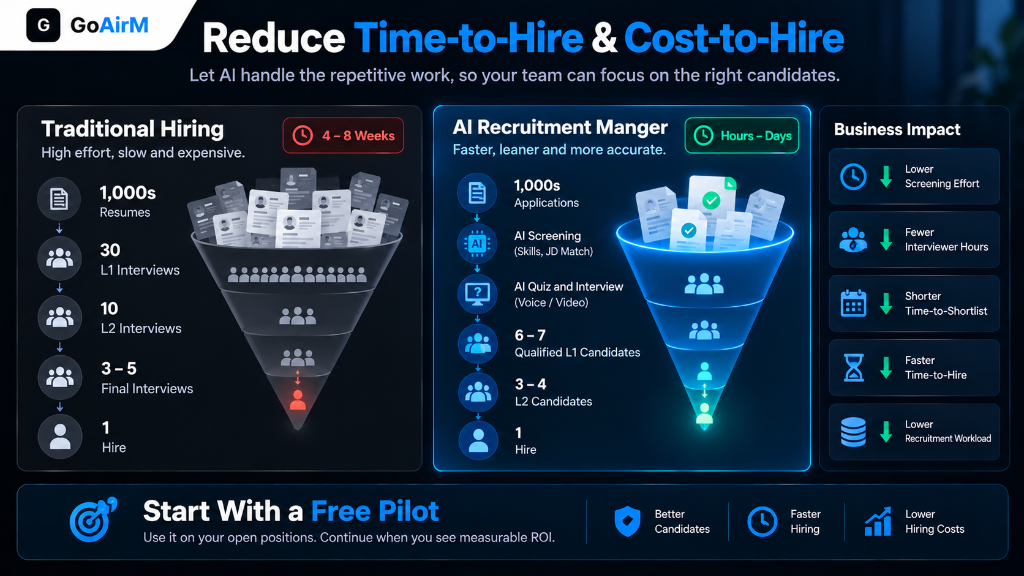
The Anatomy of Traditional Hiring: 4 to 8 Weeks of Calendar Drag
When founders and VP-level executives track time-to-hire, they often look at aggregate calendars. According to recent talent benchmarks across mid-sized tech companies, filling an engineering seat takes between 44 and 58 calendar days.
Where does that time actually disappear? Let us trace the traditional funnel step by step.
First comes the inbound avalanche. A single job posting draws anywhere from 800 to 2,500 inbound applications across LinkedIn, job boards, and referral portals. Sifting through this massive digital pile requires an internal talent sourcer to sit through thirty-five hours of mind-numbing manual triage, cross-referencing bullet points against job descriptions while squinting at poorly formatted PDFs across two agonizing work weeks.
Next comes the scheduling bottleneck. To lock down thirty viable applicants for a preliminary phone screen, a recruiter sends sixty back-and-forth emails. Calendar links get shuffled. Reschedules happen constantly. Candidates drop out because their current employers assign unexpected project crunches.
Then comes the initial interview gauntlet. Conducting thirty preliminary calls—each running thirty to forty-five minutes—burns more than twenty hours of direct human conversation. Half of those applicants turn out to have inflated resumes, struggle with basic domain questions, or lack the practical fluency claimed on their GitHub profiles.
Now consider the second stage. Ten survivors make it to deep technical or domain interviews with your senior team leads. Each session eats an hour of an engineer's afternoon, plus fifteen minutes of prep and another fifteen minutes of post-interview scorecard logging.
That burns twenty hours of top-tier engineering payroll on basic vetting. It stalls sprints. Product deadlines slip. Morale drops.
Finally, three to five finalists reach executive or panel interviews. By the time debriefs conclude and reference checks finish, six weeks have evaporated into thin air.
The Compounding Penalty of Candidate Drop-Off
Top performers rarely linger on the job market. Data consistently demonstrates that the top decile of software talent secures offers within ten to fourteen days of beginning their search, meaning that when an organization stretches its technical interview sequence across forty-five business days, it is inevitably selecting from the subset of candidates who lacked alternative market options rather than securing high-conviction industry leaders.
The Hidden Balance Sheet: What Traditional Hiring Actually Costs
Most finance departments track cost-per-hire using simplistic ledger items: job board subscriptions, recruiter seats, and external agency invoices. They calculate an average cost of roughly $4,500 to $6,000 per hire.
That calculation is incomplete. It ignores internal opportunity cost. The hidden line items are staggering.
Let us tally the real balance sheet for a mid-level or senior engineer:
- Recruiter and Sourcing Overhead: A full-time technical recruiter earning $110,000 base salary dedicating three full weeks of focused effort to a single pipeline equals $6,300 in internal talent overhead. If you rely on an external contingency firm charging 20% of first-year base salary on a $140,000 role, that single invoice hits $28,000.
- Engineering Interviewer Hours: Ten technical screens and five panel sessions consume roughly twenty-five hours of engineering time. When you pull a Principal Engineer billing an internal loaded cost of $140 an hour away from shipping mission-critical microservice architectures simply to verify whether an applicant understands asynchronous JavaScript promises, you are setting thousands of dollars of engineering momentum directly on fire.
- The Drag of Vacancy: When a mission-critical backend seat sits unfilled for seven weeks, product roadmaps slip. Features get delayed. Existing teammates carry overtime burdens, driving burnout and attrition risk.
Add those lines up. A single traditional technical hire quietly costs between $16,000 and $38,000 once you factor in recruiter bandwidth, engineering hours, and recruitment fees.
No company can sustain that leakage. It is absurd.
The GoAirM Shift: Compressing Six Weeks into Hours and Days
What if you could eliminate ninety percent of that administrative churn without sacrificing rigorous evaluation standards?
That is precisely why engineering-led organizations are adopting goairm.com. Instead of asking human recruiters to manually triage thousands of PDFs and conduct dozens of repetitive phone screens, GoAirM deploys an autonomous recruitment manager that automates the early funnel.
Here is how the hiring pipeline looks when GoAirM runs your initial screening:
1. Instant Context-Aware Screening: When thousands of applications hit your inbox, GoAirM does not rely on dumb keyword matching. It analyzes project architectures, contextual experience, and job description requirements in real time. Within seconds of submission, every candidate receives an objective, multi-factor match score.
2. Autonomous Voice and Video Screening: Qualified applicants do not wait two weeks for a recruiter's open calendar slot. They are invited to complete an interactive AI quiz and voice or video interview right away. Candidates can complete their screening at 8:00 p.m. from their living room. The AI conducts a fluid, conversational interview—probing technical claims, evaluating problem-solving steps, and testing practical domain competence.
3. Delivering High-Signal Finalists to Your Team: Instead of asking your engineering leads to interview thirty raw candidates, GoAirM narrows the funnel down to six or seven verified, high-scoring contenders. Your hiring managers receive comprehensive transcripts, behavioral rubrics, and technical assessment breakdowns before ever stepping into an interview room.
Your team meets only calibrated talent. The noise is gone. Speed wins. Quality surges.
Side-by-Side Comparison: Traditional Hiring vs. GoAirM
To grasp the operational contrast, look at the two models across core business metrics:
| Evaluation Metric | Traditional Hiring Process | With GoAirM (goairm.com) |
|---|---|---|
| Total Time to Hire | 4 to 8 weeks of staggered calendar coordination. | Hours to a few days from application to offer. |
| Screening Effort | Recruiters spend 20+ hours manually reviewing resumes. | Zero manual sorting; AI parses and scores candidates instantly. |
| Initial L1 Interviews | 30 phone screens conducted manually by recruiters or managers. | Only 6 to 7 pre-validated, top-scoring finalists reach human L1. |
| Interviewer Hours Expended | 40 to 60 expensive engineering and management hours. | Fewer than 8 hours total across the entire hiring loop. |
| Scheduling Friction | Constant back-and-forth emails, reschedules, and no-shows. | Instant, asynchronous candidate screening available 24/7. |
| Cost per Hire | $15,000 to $35,000+ (combining internal payroll and agency fees). | Dramatically lower cost; saves tens of thousands per seat. |
| Candidate Experience | Weeks of silence, opaque status updates, and ghosting. | Fast, structured evaluations with immediate progression. |
The Real Business Impact
The strategic value of modernizing your hiring loop extends far beyond administrative relief. It alters how fast your company can execute.
First, your engineering velocity stays intact. When senior developers spend thirty fewer hours on dead-end initial screens every month, that time goes directly into shipping features, refactoring architecture, and closing client deliverables.
Second, your candidate conversion rate skyrockets. Fast companies win the best talent. When you can review an application, conduct an initial AI technical voice screen, and advance an exceptional candidate to an on-site interview within seventy-two hours, top contenders say yes.
Third, your hiring standards become consistent. Human interviewers suffer from fatigue. A recruiter running their fifth phone screen at 4:30 p.m. on a Friday evaluates candidates through a very different lens than they did on Tuesday morning. An AI recruitment manager evaluates every single applicant against the identical objective rubric.
No bias. No mood swings. Pure merit.
Start With a Free Pilot
You do not need to overhaul your entire talent stack overnight to experience the difference. GoAirM offers a completely free pilot on your current open positions. Put your real job descriptions into the platform, let GoAirM screen your incoming applicants, and observe the measurable reduction in time and cost firsthand.
Visit goairm.com today and test your open roles.

Former Principal Systems Engineer and VP of Engineering who has conducted over 900 technical interviews across Series A startups and Fortune 500 tech teams.